Celcat AI Superpower Series: Timetabling at Warp Speed

17/06/2026 - Celcat

timetabling at warp speed

How Celcat AI’s Warp Speed capability compresses weeks of timetabling work into hours, giving your institution an operational advantage that conventional platforms simply cannot match.

Series
The 5 Superpowers of Native AI
Edition
4
Topic
Timetabling at Warp Speed
Read time
4 min

Speed in timetabling is not about cutting corners. It is about having the intelligence to process thousands of variables simultaneously, something no human team, however talented, can match. When timetabling is slow, everything downstream is slow too. And in higher and further education today, slow has a cost that institutions can no longer afford.


The problem

The slow timetable: the institutional cost of waiting

Traditional timetabling is a sequential, manual process. A timetabler works through one constraint at a time: a room here, a staff clash there, a module conflict somewhere else. The process is skilled, painstaking work, and it is inherently slow. In large institutions, building a timetable from scratch can take weeks. Even incremental changes take days. And every hour the timetable is unfinished, the institution is waiting.

Timetable build cycles take weeks
Large institutions routinely spend four to eight weeks building each semester’s timetable from scratch, consuming enormous staff resource that could be directed elsewhere.
Change requests create backlogs
Mid-term change requests queue behind the next available timetabler. A request that takes minutes to understand takes days to implement, causing frustration for staff and students alike.
Late publishing delays everything
Slow timetabling means late publishing. Students cannot plan. Staff cannot prepare. Academic support, library bookings and transport arrangements all sit in limbo waiting for a schedule.
Errors compound under time pressure
When teams are rushing to finish under deadline, clashes and conflicts are missed. Errors that would take seconds to prevent take hours to untangle once discovered.
Reactive mode becomes the default
Teams that are always building or fixing timetables have no capacity for strategic thinking, proactive planning or quality improvement. Speed deprivation creates a perpetual firefighting culture.
Competitive disadvantage accumulates
Institutions that publish timetables later, respond to changes slower and operate with less agility are visible to students and staff, and increasingly compared unfavourably to those that do not.

In timetabling, slow is not neutral. Every day of delay has a cost, in staff time, student satisfaction and institutional reputation.

“The timetable is the operating system of your institution. When it runs slowly, everything runs slowly.”


The native AI advantage

Superpower 4: Timetabling at Warp Speed

Conventional platforms are fast at storing timetabling data. They are not fast at building timetables. The work of resolving constraints, allocating rooms, managing staff availability and avoiding clashes still falls on a human timetabler working sequentially through the problem.

Celcat AI is architecturally different. Because intelligence is at its core, it deploys its cohort of autonomous agents simultaneously across every dimension of the timetable, resolving constraints in parallel, allocating resources in real time, and completing in hours what would otherwise take weeks. This is Timetabling at Warp Speed: not faster humans, but a fundamentally different class of capability.

Superpower 4 of 5

Warp Speed: compressing weeks of timetabling work into hours, without sacrificing quality or compliance.

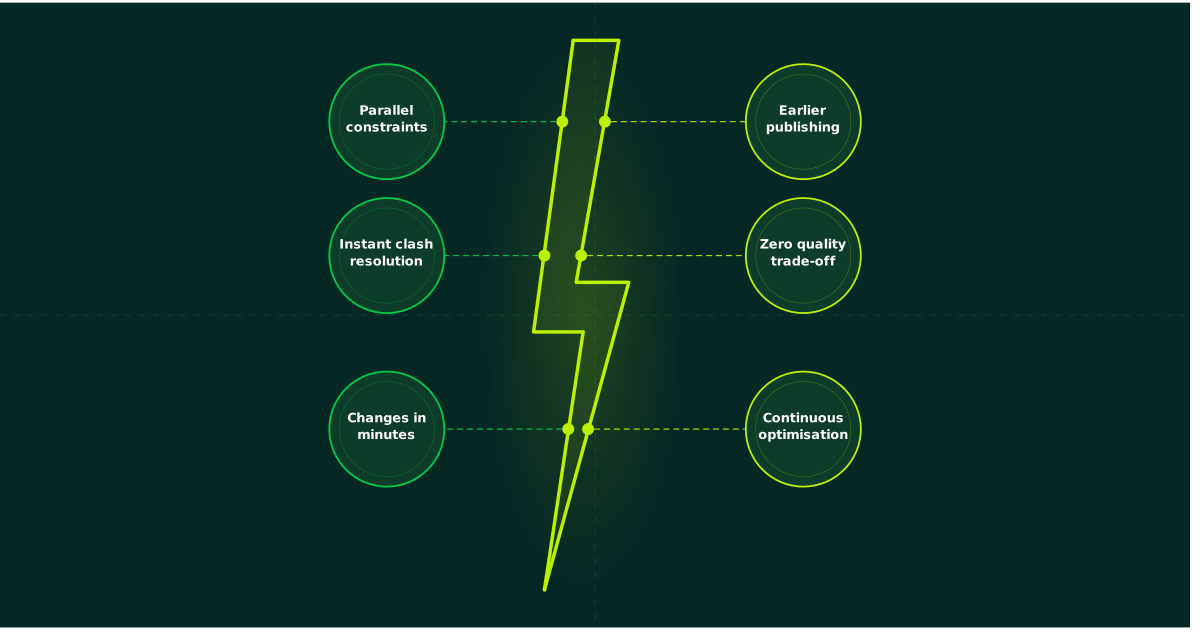
Six dimensions of speed that are only possible on a native AI platform, each delivering an operational advantage that conventional platforms simply cannot replicate.

Speed 1
Parallel constraint resolution
All constraints processed simultaneously by multiple agents, not sequentially by a single timetabler working through a list.
Speed 2
Instant clash detection and resolution
Clashes identified and resolved in real time as the timetable is built, with no separate validation phase and no post-build correction cycle.
Speed 3
Change requests in minutes
Mid-term changes processed instantly. The AI re-optimises the affected area of the timetable without disrupting everything around it.
Speed 4
Earlier publishing, every term
Timetables completed and published weeks before conventional deadlines, giving students, staff and support services the certainty they need.
Speed 5
Zero quality trade-off
Speed does not mean shortcuts. Every room, every session, every allocation is optimised, with compliance maintained and student experience protected throughout.
Speed 6
Continuous real-time optimisation
The timetable never stops being optimised. As conditions change, the AI adapts, delivering an ever-improving schedule throughout the term.

Before and after: the Warp Speed difference
Without Warp Speed
4–8 weeks to build a semester timetable
Changes take days, backlogs grow
Clashes found after build, not during
Teams stuck in reactive firefighting
Speed and quality always in tension
Celcat AI — Warp Speed
Timetables built in hours, not weeks
Changes processed in minutes, no backlog
Clashes resolved in real time as the build runs
Teams freed for strategic, high-value work
Speed and quality improve simultaneously

What Warp Speed delivers for your institution

Timetables published weeks earlier, every single term
Change requests resolved in minutes, not days
Timetabling teams freed from production and into strategy
Higher student and staff satisfaction from day one
A timetable that keeps improving throughout the term
An operational advantage competitors cannot easily match

No conventional platform can replicate this. Speed at this level requires AI that is woven into the architecture of the system, processing constraints in parallel, resolving clashes autonomously and optimising continuously. This is not a feature you can add to a legacy system. It is the result of building for intelligence from day one.

With Celcat AI, your institution stops being defined by how long timetabling takes. It starts being defined by how fast it moves.


Coming in this series

The 5 Superpowers of Native AI

Series roadmap
4
Timetabling at Warp Speed
5
Strategy-Resilient Timetabling

See Warp Speed in action

Book a live demonstration and watch Celcat AI build, optimise and publish a timetable at a speed your team has never seen before.

Book a Demo

By this time next term...

… you could be fully up and running with our easy-to-use software.

To get in touch, please contact us via this form, or call us on +44 (0)24 7646 9930. If we are not available immediately, a member of our team should be able to get back to you within a few hours.

You can read more about typical migration times here.

    Back to top